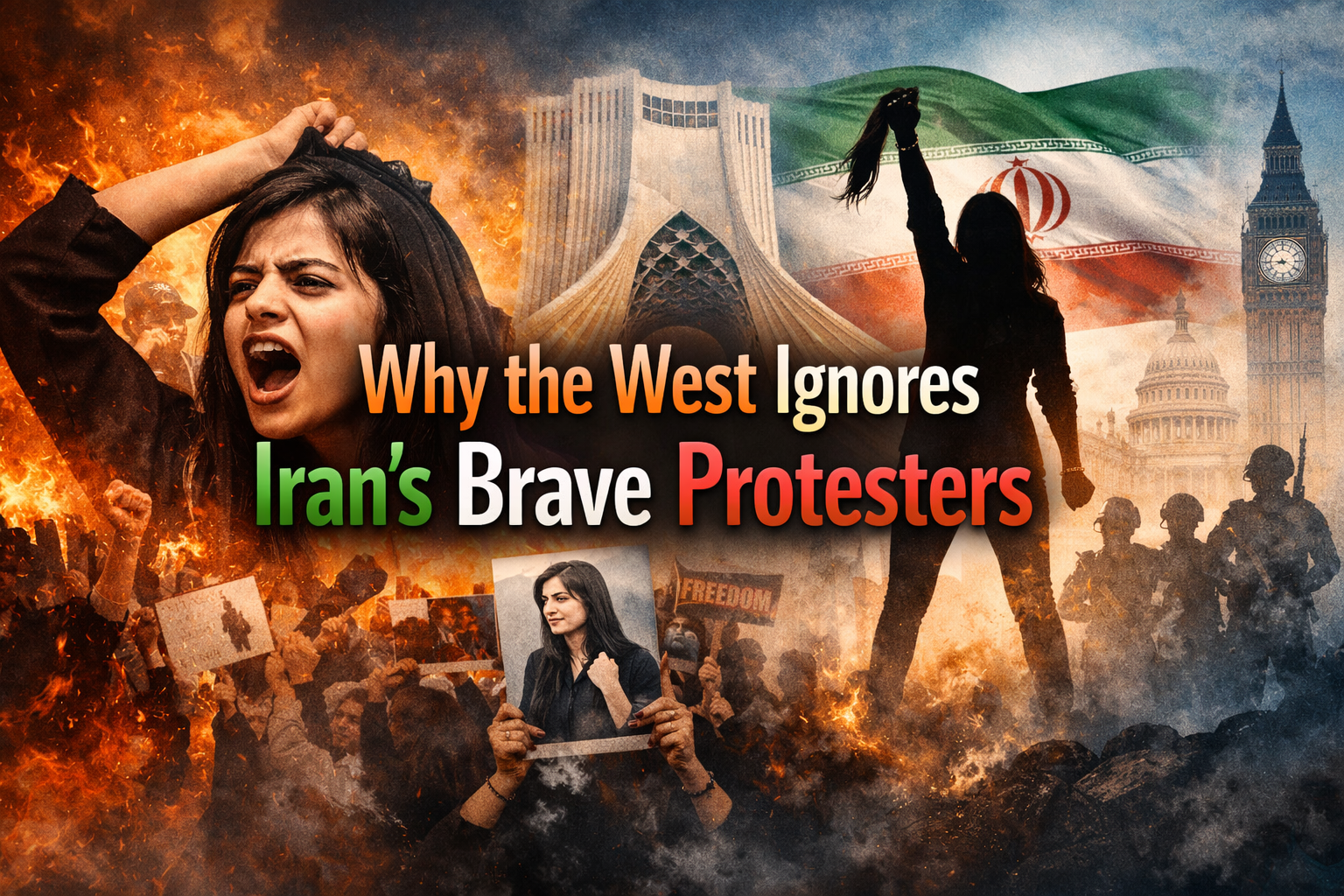
The streets of Tehran tell a story the Western establishment refuses to hear. Young women burn their hijabs in defiance of a theocratic regime that murdered Mahsa Amini for showing her hair. Students chant “Death to the Dictator” in university courtyards, risking torture and execution. Protesters face live ammunition from security forces, yet Western campuses remain quiet. The same activists who organize vigils for every fashionable cause seem to have lost their voices when it comes to Iran’s freedom fighters.
This selective silence reveals something profound about the modern Western left, mainstream media, and political establishment: their professed concern for human rights is less about universal principles than about maintaining a carefully constructed ideological framework where only certain victims matter.

The Architecture of Selective Outrage
The pattern is impossible to ignore once you see it. When Iranian security forces gun down protesters demanding basic freedoms, Western universities don’t organize solidarity marches. When the morality police beat women to death for dress code violations, campus activists don’t occupy administration buildings. When the Islamic Republic hangs gay men from cranes, the same organizations that celebrate Pride Month with corporate sponsorship remain conspicuously silent.
Yet these same institutions mobilize with stunning speed when the narrative fits their ideological framework. A single incident involving the “correct” demographic categories triggers immediate campus-wide responses, media saturation, and political grandstanding. The disparity isn’t accidental—it’s structural.
As I explore in The Enemy Within: How the West Is Destroying Itself, Western institutions have adopted an ideological lens that categorizes human suffering not by its severity but by its utility in advancing a predetermined narrative. This framework divides the world into oppressors and the oppressed based on immutable characteristics rather than actual power dynamics or moral culpability.

The Racial Calculus of Compassion
Modern Western progressivism operates on a hierarchy of victimhood where your position determines whether your suffering matters. This explains the perverse reality where universities that claim everything relates to race and identity suddenly lose interest in both when examining Iran’s brutality.
Iranian women fighting for basic freedoms should be feminist heroes by any rational standard. They’re literally risking death to remove state-mandated religious dress codes. Yet Western feminists, who organize marches over domestic political disagreements, offer little more than token statements before returning to their comfortable crusades.
Why? Because Iranian protesters don’t fit the narrative template. The Islamic Republic can’t be cast as a white supremacist patriarchy. The brave women of Iran can’t be framed as victims of Western colonialism. The protesters themselves often explicitly oppose the kind of identity politics that dominates Western discourse. They’re fighting for individual liberty, not collective grievance.
This creates an ideological paradox that the Western left resolves through silence. Better to ignore Iranian freedom fighters entirely than acknowledge that the most authentic resistance to patriarchal oppression is happening in a non-Western, Islamic context and targets a regime the Western left has historically been reluctant to condemn.

The Immigrant Crime Enigma
The same selective blindness applies to a crisis unfolding across Europe and increasingly in North America. The sexual assault and murder of women by migrants—documented extensively in countries like Sweden, Germany, and the UK—should theoretically galvanize the same activists who claim to champion women’s safety. Instead, these cases are downplayed, their perpetrators’ backgrounds obscured, and anyone drawing attention to patterns is accused of racism.
The data is stark. Sweden, once one of Europe’s safest countries for women, now has the second-highest rape rate in the world after Lesotho, with the increase correlating directly with mass immigration from Muslim countries.

Germany experienced a wave of sexual assaults during New Year’s Eve celebrations in Cologne in 2016, with over 1,200 women reporting attacks by men predominantly from North African and Middle Eastern backgrounds. The UK’s grooming gang scandals revealed organized sexual exploitation of thousands of predominantly white working-class girls by gangs of predominantly Pakistani heritage men—crimes that authorities deliberately ignored for years out of fear of being labeled racist.
Yet when a white man commits violence against a non-white woman, the response is immediate and categorical. The incident becomes a teaching moment about systemic racism, toxic masculinity, and white supremacy. Vigils are organized, petitions circulated, and institutional reforms demanded.
The double standard couldn’t be clearer: immigrant perpetrators receive the soft lens of “complexity” and “cultural context,” while native perpetrators are presented as exemplifying broader social pathologies. One set of victims receives full media coverage and political advocacy; the other is quietly forgotten lest their suffering complicate the preferred narrative.

The Profit Motive Behind the Posturing
Understanding this pattern requires recognizing that much of what passes for social justice activism has become a lucrative industry. Universities have built entire departments around identity-based grievance studies. Consulting firms charge corporations millions to conduct “diversity, equity, and inclusion” training. Nonprofit organizations raise enormous sums by positioning themselves as defenders of marginalized communities.
This apparatus requires a steady supply of approved victims and villains. The framework can’t accommodate Iranian women fighting theocracy or European women victimized by migration policies because these cases threaten the ideological foundation on which the entire industry rests. Acknowledging them would require admitting that oppression isn’t neatly distributed along Western racial categories, that non-Western cultures can be deeply patriarchal and homophobic, and that immigration policy involves legitimate tradeoffs rather than simple moral binaries.
There’s no grant money for supporting Iranian protesters. No consulting contracts emerge from questioning migration policies. No prestigious faculty positions come from challenging the narrative that Western societies are uniquely oppressive. The incentive structure of modern activism pushes toward ever-narrower definitions of acceptable causes and victims.

The Media as Narrative Gatekeepers: An Alliance with Islamism
Mainstream media’s silence on Iran isn’t mere editorial oversight; it’s ideological complicity. Western media outlets, human rights organizations, and universities have forged an unspoken alliance with Islamist narratives, one that casts the white Westerner as history’s eternal oppressor and Islamic movements as righteous resistance fighters against colonial domination. This framework isn’t cynical calculation; it’s a genuine belief, a worldview so deeply embedded in institutional culture that contradictory evidence is simply filtered out.
The BBC offers perhaps the most documented case study. During the Israel-Gaza war, the broadcaster faced internal turmoil when journalists were disciplined—some reportedly fired—for presenting facts that challenged the approved narrative about Hamas and Palestinian victimhood. But the BBC isn’t an outlier; it’s emblematic. From the New York Times to CNN, from Human Rights Watch to Amnesty International, from Harvard to Berkeley, the same ideological framework dominates: Western civilization, particularly its white majority populations, represents the primary source of global oppression, while movements opposing the West—even brutally authoritarian theocracies—deserve sympathetic understanding as victims fighting back against historical injustice.

Photo credit – ILTV
This explains why Iranian protesters vanish from coverage while Palestinian grievances receive endless attention. It explains why the Islamic Republic’s execution of gay men, systematic oppression of women, and slaughter of peaceful demonstrators generate less sustained outrage than Israeli self-defense operations. Iran’s theocrats aren’t white, aren’t Western, and position themselves against American and Israeli power—therefore, within the prevailing framework, they occupy a more sympathetic position than their victims.
The belief system transcends traditional political boundaries. Both left and right have proven susceptible to romanticizing Islamist authoritarianism when it serves their narrative needs. Tucker Carlson, darling of the American right, provided a perfect illustration when the Iranian regime, after shutting down internet access to prevent protesters from communicating with the outside world, broadcast his interview segments praising aspects of the Islamic Republic. The regime understood what Carlson apparently didn’t: his anti-establishment posturing made him useful for whitewashing theocratic brutality, and his massive audience would see carefully edited clips presenting Iran’s dictatorship in a favorable light.

The left’s version is equally revealing but more directly hypocritical given its claimed commitment to human rights. Ana Kasparian of The Young Turks, a progressive commentator who regularly champions marginalized groups, stated explicitly that she opposed regime change in Iran if it came through Israeli or American intervention. Read that again: she announced that the freedom of 85 million Iranians mattered less to her than ensuring their liberation didn’t involve the “wrong” actors. Her primary concern wasn’t the women being beaten to death by morality police or the students being tortured in Evin Prison—it was her ideological revulsion toward white, Western, and Jewish power.
This is the logic of someone for whom anti-Western ideology has become more important than the actual humans suffering under tyranny. Kasparian’s statement reveals the ultimate endpoint of the framework: Iranian women’s lives are less valuable than maintaining the narrative that Western/Israeli intervention is always imperialism and never liberation. The possibility that Iranians themselves might welcome outside support in overthrowing their oppressors—as many Iranian activists have explicitly stated—doesn’t register because it contradicts the predetermined script.
And the same logic plays when the left protest againsgt the liberation of Venezuela –
The pattern repeats across institutions. When protests erupted following Mahsa Amini’s murder, they received initial coverage but quickly faded from headlines. There were no campus encampments for Iranian freedom, no celebrity social media campaigns, no corporate solidarity statements. The same universities that organize immediate responses to domestic controversies remained silent when Iranian students faced live ammunition for demanding basic rights. Why? Because the Iranian regime can’t be cast as an instrument of white supremacy or Western imperialism.
The protesters themselves often reject the identity politics framework dominant in Western progressivism. They’re fighting for individual liberty and secular governance, concepts the contemporary left treats with suspicion when they emerge from “oppressed” populations who are supposed to embrace collective identity and anti-Western politics.
Human rights organizations follow the same pattern. Amnesty International and Human Rights Watch, which dedicate enormous resources to documenting Israeli actions, produce comparatively little sustained advocacy for Iranian protesters. Their reports exist but generate minimal institutional energy. The reason is structural: these organizations increasingly operate within the same ideological framework as progressive media and academia, one that implicitly ranks human rights violations by whether they fit approved narratives about power and oppression.
This creates a perverse moral calculus where Iranian women fighting theocratic misogyny receive less support than Palestinian women living under Hamas rule, where gay Iranians hanged from cranes generate less outrage than gay Palestinians claiming victimhood by Israel, and where secular Iranian students demanding freedom are less sympathetic than religious extremists framed as anti-colonial resistance. In each case, the determining factor isn’t the severity of oppression or the justice of the cause—it’s whether acknowledging the victims would require admitting that non-Western, non-white, Islamic societies can be deeply oppressive and that their victims might welcome Western support.
The media’s transformation from information providers to narrative managers is nearly complete. “Journalistic objectivity” has been explicitly rejected by many major outlets in favor of “moral clarity”—a framework that begins with predetermined conclusions about who deserves sympathy and which stories advance progressive goals. Stories about Iranian freedom fighters don’t serve those goals because they reveal uncomfortable truths: that some of the most authentic resistance to patriarchal religious oppression is happening in the Islamic world, that victims of these regimes often admire aspects of Western liberalism, and that the primary obstacle to their freedom isn’t Western imperialism but indigenous authoritarianism.
Coverage decisions now follow a predictable pattern: extensive, sustained reporting on events that confirm existing narratives (Western racism, police brutality, Israeli aggression), minimal attention to events that challenge them (Islamist oppression, immigrant crime, Iranian protests). When the George Floyd protests erupted, they dominated news cycles for months, sparked international solidarity movements, and generated endless analysis pieces connecting his death to systemic racism. When Mahsa Amini was murdered by Iran’s morality police, she received brief attention before the media moved on. The difference isn’t journalistic—it’s ideological.
Floyd’s death fit perfectly into the approved narrative: white supremacy, police violence, systemic racism. Amini’s murder created complications: a theocratic Islamic regime, religious oppression, protesters waving pre-revolution Iranian flags, and sometimes even expressing admiration for Israel as the region’s only democracy. One story reinforces what Western institutions want to believe about themselves and the world; the other fundamentally challenges those beliefs.
The result is a media landscape where audiences receive not comprehensive information but curated narratives designed to advance ideological conclusions. Iranian protesters disappear from coverage not because their struggle is less compelling or their oppression less severe, but because sustained attention would require acknowledging that the most brutal patriarchies, the most violent homophobia, the most systematic oppression of women exist not in Western democracies but in societies the progressive framework has implicitly positioned as victims rather than victimizers.
This isn’t journalism, it’s propaganda in service of an ideology that has become more important to institutional gatekeepers than truth, more central to their identity than the universal human rights they claim to champion. And until Western media, universities, and human rights organizations are willing to apply their stated principles consistently, celebrating Iranian freedom fighters with the same energy they devote to approved causes, condemning Islamist brutality with the same vigor they direct at Western democracies, their claims to moral authority are exposed as hollow performance masking ideological rigidity and, ultimately, complicity with oppression.
The Cost of Silence
This selective attention carries real consequences. When Western institutions ignore Iranian protesters, they deny them the international solidarity that could provide some protection and legitimacy. When the media refuses to cover their struggle consistently, it signals to the Iranian regime that the world isn’t watching closely. When universities remain silent, they abandon principles of free speech and human dignity in favor of ideological convenience.
The same dynamics that lead to ignoring Iran’s freedom fighters also enable the cover-up of immigrant crime patterns, sacrificing women’s safety on the altar of ideological purity. In both cases, real people suffer while those who claim to champion the vulnerable look away because acknowledging these victims would require questioning their worldview.
This represents a profound moral failure. Human rights are either universal or they’re meaningless. Suffering either matters or it doesn’t. When institutions claim to care about justice while applying their concern selectively based on whether victims fit approved categories, they reveal that their professed values are performative rather than principled.
Breaking the Silence
Recognizing these patterns is the first step toward demanding better. Citizens can pressure media outlets to provide consistent coverage of human rights abuses regardless of whether they fit fashionable narratives. Students can challenge universities to apply their stated principles universally rather than selectively. Voters can support politicians who prioritize actual human rights over ideological posturing.
Most importantly, individuals can refuse to accept the framework that divides victims into worthy and unworthy categories based on identity. Iranian women fighting for freedom deserve support, not because of their race or religion, but because they’re fighting for universal human rights. European women victimized by criminal violence deserve protection not based on the perpetrators’ backgrounds but because they’re human beings entitled to safety.
The Western establishment’s silence on Iran while it obsesses over approved causes reveals the hollowness at the heart of contemporary progressive politics. What masquerades as sophisticated moral thinking is actually a crude calculus that values narrative convenience over human dignity, ideological conformity over truth, and political advantage over principle.
Until Western institutions- media, universities, activist organizations, and political parties- are willing to apply their stated values consistently, their claims to moral authority ring hollow. The brave Iranians in the streets deserve better than selective sympathy from a Western elite more interested in maintaining ideological purity than defending universal human rights.

The silence isn’t an oversight. It’s a choice, and it tells you everything you need to know about the true priorities of those who claim to speak for justice while carefully controlling whose voices get heard.
For a comprehensive examination of how Western institutions have prioritized ideology over truth and principle, undermining the very civilizations they claim to protect, see The Enemy Within: How the West Is Destroying Itself.
For analysis of how selective narrative construction shapes Middle Eastern discourse specifically, watch for the forthcoming The Palestinian Myth: Deconstructing the Narrative, Revealing the Truth.


Leave a Reply