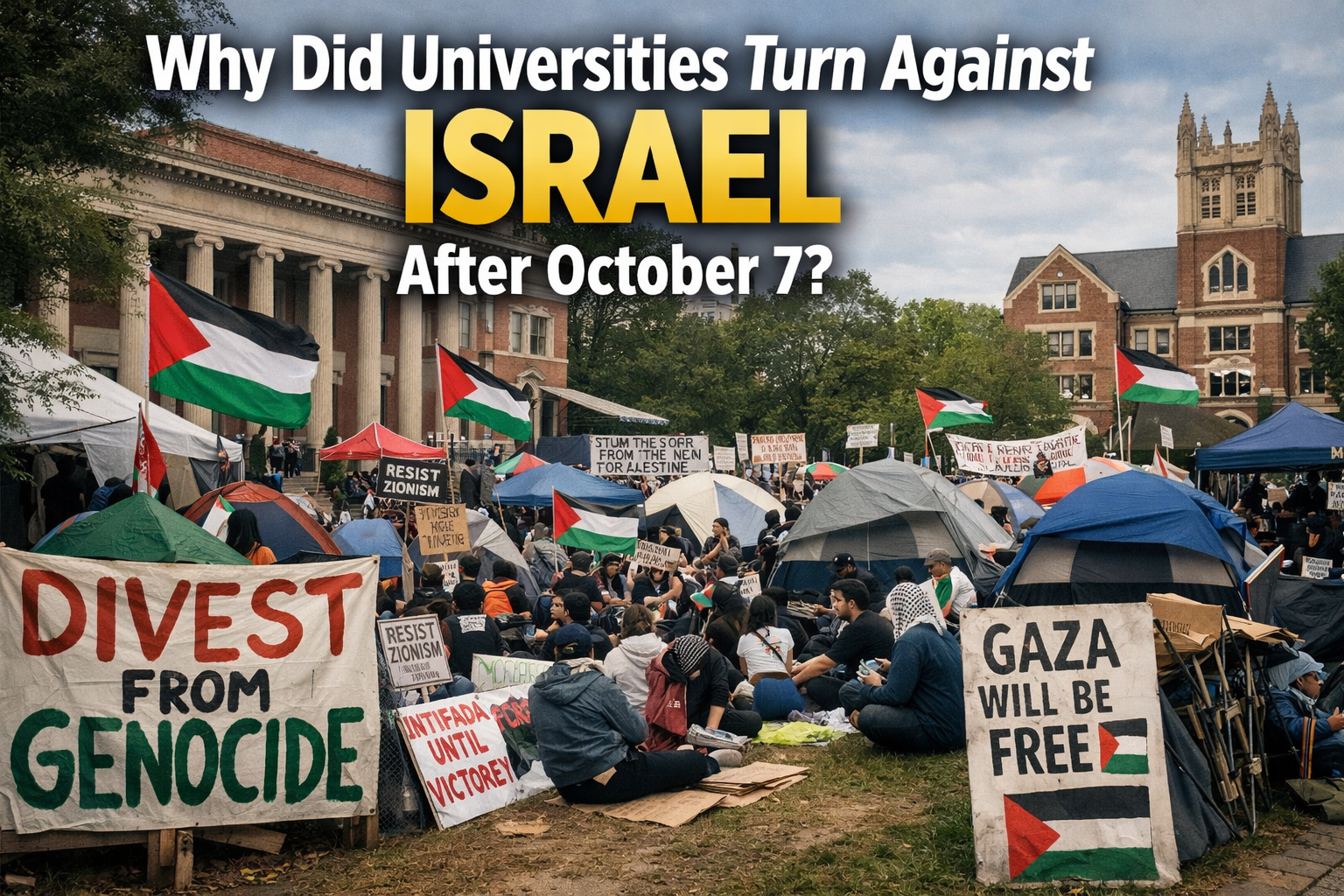
The campus eruptions weren’t spontaneous. They were decades in the making—and billions of dollars in funding.
The Day Academia Chose Sides
October 7, 2023, was the deadliest day for Jews since the Holocaust.
Hamas terrorists slaughtered 1,200 people—babies burned alive, women raped and paraded through Gaza, families executed in their homes. The brutality was unimaginable. The cruelty is deliberate.
And on American college campuses, students celebrated.
At Harvard, over 30 student organizations released a statement holding Israel “entirely responsible” for the massacre—before Israel had even responded. At Columbia, pro-Palestinian students cheered. At NYU, they chanted “From the river to the sea.” At Cornell, a professor called the attacks “exhilarating” and “energizing.”
This wasn’t fringe behavior. This was mainstream campus culture.
Jewish students were harassed, threatened, and assaulted. Menorahs were torn down. Posters of kidnapped Israelis were ripped from walls. Students who dared to mourn were shouted down, doxxed, and told they weren’t welcome.

And university administrators? They stayed silent.
So the question everyone is asking is: How did we get here?
How did American universities—institutions that pride themselves on tolerance, diversity, and inclusion—turn into breeding grounds for hatred of the Jewish state?
The answer is simple: This didn’t start on October 7th.
This started 40 years ago.
One Book Changed Everything
If you want to understand why universities hate Israel, you need to understand one man: Edward Said.
In 1978, Said, a Palestinian-American professor at Columbia University, published a book called Orientalism. It’s one of the most influential books in modern academia—and one of the most destructive.

Said’s thesis was simple: Western scholars have consistently misrepresented the Middle East. They’ve painted it as backward, exotic, and inferior to justify colonialism. “Orientalism,” he argued, was a tool of oppression—a way for the West to control and dominate the East.
And Israel, in Said’s framework, was the ultimate example of Western colonialism in the Middle East.
The book became gospel in academia. It birthed an entire field—postcolonial studies—that views the world through a single lens: oppressor vs. oppressed. Colonizer vs. colonized. West vs. East.
And in that binary, Israel is always the villain.
Said’s ideas didn’t just stay in the classroom. They infected Middle Eastern Studies departments across the country, reshaping how an entire generation of professors taught students to think about Israel, Palestine, and the broader Middle East. Suddenly, it wasn’t about facts or history. It was about narrative—and the Palestinian narrative became the only acceptable one.
As I trace in The Palestinian Myth: Deconstructing the Narrative, Revealing the Truth, Said’s work laid the foundation for a mythology that replaced historical inquiry with ideological certainty. The story of Israel as a colonial project wasn’t debated—it was assumed. And any challenge to that story was dismissed as “Orientalist” or worse.
The Money: Who Paid for This?
Ideas don’t spread by accident. They spread because someone funds them.
And when it comes to anti-Israel sentiment on campuses, the money trail is impossible to ignore.
Between 2001 and 2021, American universities received over $10 billion in funding from Middle Eastern countries—most of it from Qatar and Saudi Arabia.
Qatar alone has donated over $4.7 billion to American universities. Georgetown, Northwestern, Cornell, and Texas A&M—all have campuses in Doha, funded by the Qatari government. And Qatar isn’t just funding buildings. It’s financing professors, research, and entire academic programs.
Why does this matter? Because Qatar also funds Hamas. It hosts Hamas leaders. And it runs Al Jazeera, the propaganda arm of the Palestinian cause.
Saudi Arabia has poured billions more into Middle Eastern Studies programs, many of which teach a version of history that demonizes Israel and glorifies the Palestinian “resistance.”
This isn’t charity. Its influence.

Universities are supposed to be places of free inquiry. But when billions of dollars come from authoritarian regimes with a vested interest in delegitimizing Israel, that inquiry stops being free.
The narrative becomes fixed. The conclusions are predetermined.

The Machine: How It Works on Campus
The anti-Israel movement on campuses isn’t grassroots. It’s organized. Funded. Coordinated.
At the center of it all is a network of groups that work in tandem to shape campus discourse, silence dissent, and radicalize students.
Students for Justice in Palestine (SJP) is the most visible. Founded in the 1990s, SJP chapters now operate on over 200 campuses across the U.S. They organize protests, coordinate boycott campaigns, and create “Israeli Apartheid Week” events that dominate campus life every spring.
But SJP doesn’t act alone. It’s supported by national organizations like American Muslims for Palestine (AMP), which provides training, materials, and funding. AMP’s leadership has documented ties to Hamas-affiliated groups, and its messaging mirrors Hamas propaganda almost word for word.
Then there’s Jewish Voice for Peace (JVP), an anti-Zionist group that positions itself as “the Jewish alternative” to support for Israel. JVP provides cover for the movement—a way to say, “See? Even Jews agree with us.”
And behind all of them are professors.
Middle Eastern Studies departments are overwhelmingly hostile to Israel. Professors assign Said’s Orientalism as required reading. They invite speakers who call Israel an “apartheid state” or a “settler-colonial project.” They frame the Israeli-Palestinian conflict not as a complex territorial dispute, but as a moral binary: oppressor vs. oppressed.
Students don’t just learn this narrative. They’re immersed in it. And by the time they graduate, they believe it without question.
The Narrative: “Indigenous vs. Colonizer”
The most potent weapon in the anti-Israel arsenal isn’t facts. It’s language.
Listen to any campus protest, and you’ll hear the exact phrases repeated like a mantra:
- “Apartheid”
- “Genocide”
- “Settler colonialism”
- “Indigenous land”
This isn’t spontaneous. It’s scripted.
The Palestinian cause has been repackaged to fit perfectly into the progressive framework that dominates academia. It’s no longer about a territorial dispute between two peoples with competing claims. It’s about a simple story: Indigenous Palestinians vs. White European colonizers.
Never mind that Jews are indigenous to the land. Never mind that half of Israel’s population is Mizrahi—Jews from Arab countries who were ethnically cleansed from the Middle East. Never mind that “Palestine” was never a country, never had a government, and never existed as an independent state.
None of that matters.
Because in the woke framework, complexity is the enemy. Nuance is a distraction. The only thing that matters is the oppression hierarchy—and in that hierarchy, Palestinians rank higher than Jews.
Palestinians are “people of color.” Israelis are “white.” Palestinians are “stateless.” Israelis have “power.” Palestinians are “victims.” Israelis are “oppressors.”
It’s a clean, straightforward narrative. And it’s incredibly effective.
As I explore in The Enemy within – How the west is destroying itself, this narrative didn’t emerge organically. It was constructed, refined, and promoted through decades of advocacy, academic propaganda, and international diplomacy. It’s a myth—but it’s a myth that has reshaped global discourse about the Middle East.
Why Jews Became “White Colonizers”
Here’s the question no one wants to ask: Why did Jews—historically one of the most persecuted groups in human history—suddenly get reclassified as oppressors?
The answer lies in victimhood culture.
In the progressive framework, victimhood is currency. The more oppressed you are, the more moral authority you have. And Jews, for all their historical suffering, made one fatal mistake:
They succeeded.
After the Holocaust, Jews didn’t stay broken. They built a state. They thrived. They became doctors, lawyers, scientists, and entrepreneurs. They contributed disproportionately to culture, medicine, and innovation.
And in victimhood culture, success disqualifies you from sympathy.
Jews aren’t seen as survivors of genocide. They’re seen as powerful, wealthy, and therefore complicit in oppression. Israel isn’t seen as a refuge for a persecuted people. It’s seen as a colonial project backed by Western imperialism.
This is how Jews were reclassified. They went from “victims of the Holocaust” to “white-adjacent” to “colonizers.” And once that shift happened, the left had no problem abandoning them.
Palestinians, on the other hand, fit the mold perfectly. They’re “stateless.” They’re “people of color.” They’re “resisting occupation.” In the oppression Olympics, they rank higher than Jews—and that’s all that matters.

The playbook that turned Jews into villains on campus is the same playbook that’s destroying Western civilization from within. It’s a worldview that celebrates grievance, punishes achievement, and divides people into rigid categories of oppressor and oppressed. I examine this dynamic in depth in The Enemy Within: How the West Is Destroying Itself, because what’s happening to Jews on campus is a symptom of a much larger disease.

The Cost: What Happened to Jewish Students
This isn’t just an ideological debate. It’s personal.
After October 7th, Jewish students became targets.
At Cooper Union, Jewish students barricaded themselves in the library while pro-Palestinian protesters banged on the doors, chanting “Free Palestine.” At Cornell, a student posted threats to “stab any Jew I see on campus” and “shoot up” a Jewish center. At Columbia, Jewish students were told to stay home for their own safety.
Mezuzahs were torn from dorm rooms. Stars of David were equated with swastikas. Students wearing kippahs were harassed, spat on, and assaulted.
And what did universities do?
Not much.
Some released tepid statements condemning “all forms of hate.” Others stayed silent. A few even defended the protesters’ right to free speech, while Jewish students were being threatened.
Harvard’s president, Claudine Gay, couldn’t bring herself to say that calling for the genocide of Jews violated Harvard’s code of conduct. When asked directly, she said it “depends on the context.”
The message was clear: Jewish students don’t matter.
Their safety is negotiable. Their trauma, dismissed. Their identity, erased.
This is the cost of decades of propaganda. A generation has been taught that Jews are oppressors, that Israel is evil, and that any violence against them is “resistance.”
And now, Jewish students are paying the price.
This Is Just the Beginning
October 7th exposed something that’s been building for decades.
American universities aren’t neutral spaces for learning. They’re ideological factories, churning out graduates who believe Israel is illegitimate, Jews are complicit, and violence in the name of “liberation” is justified.
This isn’t going away. It’s getting worse.
The students celebrating Hamas today will be tomorrow’s journalists, lawyers, politicians, and professors. They’ll carry this hatred into every institution they enter. And unless something changes, the next generation will be even more radicalized than this one.
The question isn’t just why universities turned against Israel.
The question is: What are we going to do about it?
For a deeper look at how the Palestinian narrative was constructed and why it’s reshaping global discourse, read The Palestinian Myth: How History is Being Rewritten to Erase Israel and take over the West The truth is out there. The question is whether we’re willing to face it.

Much Love
Y
Related posts:
 Your Kids Are Being Taught to Hate America (And You’re Paying $90K for It): The Columbia University Case Study.
 From College Brainwashing to City Hall: How Anti-American Activists Are Running Your Town
 Tucker Carlson: Antisemite and Anti-American of the Year
 How Victimhood Culture Is Destroying Western Civilization: From Cancel Culture to Campus Chaos
Leave a Reply