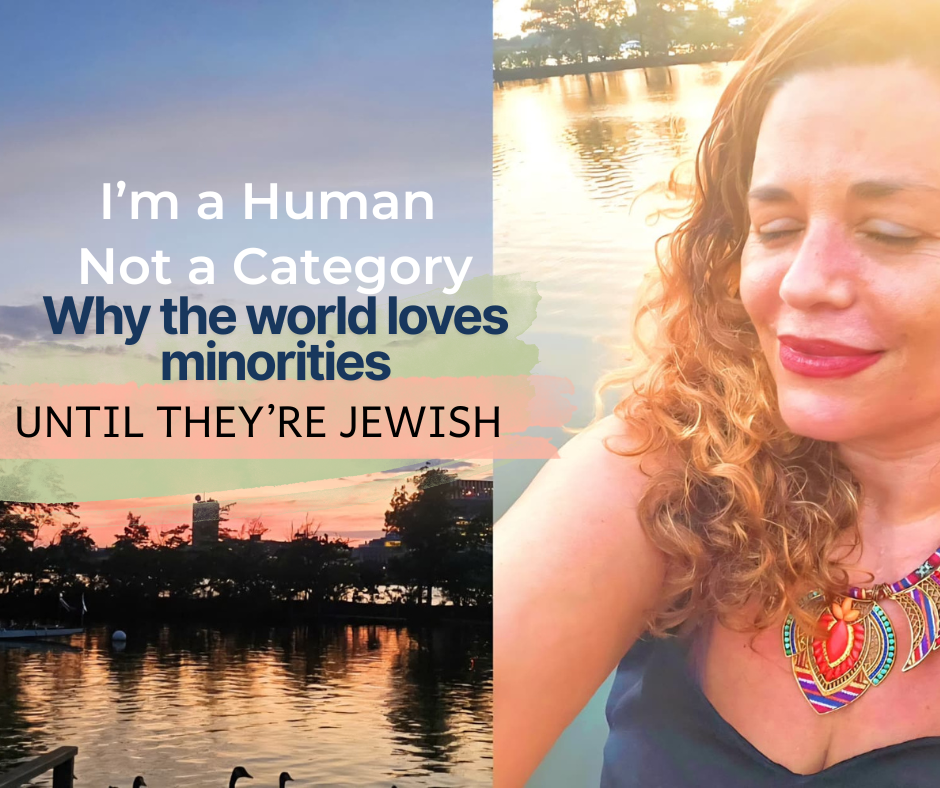
Why the world loves minorities—until they’re Jewish
It was a breezy summer afternoon at the beer garden in Boston’s Esplanade, the kind of moment that makes you pause and fall in love with life again. I was sitting with my close Korean friend, laughing, sipping craft beer, soaking in the sun, and the rare lightness that this city sometimes grants you.

Next to us, a couple was clearly on a third date—the kind where the flirtation is starting to deepen into genuine curiosity. Our conversations eventually intertwined. The young African-American man, Rich Goods, shared his thoughts about dating and identity — how moving as a teenager into a predominantly white area changed his sense of self. He said that being Black made it harder to find a connection, that it felt easier to date outside his race because, in his words, “there weren’t even options.”
I leaned in. I related.
As an Israeli immigrant in the U.S., I’ve also gravitated toward those who share my culture. It’s not just habit — it’s safety. It’s easy. It’s shared language, subtle codes, and humor. I told Rich I understood, that I too sometimes felt like an outsider looking in. I thought we were bonding.
But the mood turned sharply when I mentioned I was Israeli.
Suddenly, I was no longer someone from a marginalized group. I wasn’t someone navigating exile and identity. I was, to him, a symbol — a colonizer, an oppressor, a “Nazi,” a “child-killer.” His body language shifted, his voice raised. The connection we had just built shattered. He didn’t ask where I came from, what I believed, or whether I agreed with the war. I was no longer a person to him. I was a category.
Let me be clear: it’s not the anger I found disturbing — anger over war is valid. Grief is real. Protest is sacred. What was disturbing was the selective moral outrage. While minorities are being massacred in Sudan, Syria, Yemen, and even within extremist Islamic regimes, there’s silence. No protest. No Instagram post. No global outrage. Somehow, Jewish existence remains uniquely controversial.
And then there’s the quiet erasure — the whitening of Jewish identity to fit a convenient binary. Many people assume Jews are “white” because it fits an American framework of power. But the truth is far more complex. Only around 40% of Israeli Jews are of European descent. The rest come from North Africa, the Middle East, and Asia. My own mother was born in India. Her ancestors were exiled, displaced, but held onto their Jewish identity in small communities near Bombay. She remembers lighting Shabbat candles as a girl, in a home far from Europe. She never had whiteness to cling to — only tradition.

To flatten Jewish identity into a “white colonialist” narrative isn’t just historically wrong — it goes against the very values that liberalism claims to uphold: pluralism, curiosity, the right of marginalized peoples to define themselves, not be defined by others.
Rich, if you ever read this — and others who think they’re standing for justice by simplifying reality into black and white — I urge you: pause. Ask. Listen. Not everything can be filtered through the American racial lens. Not all oppression looks the same. Not every immigrant story ends in privilege.
You may have triggered a few anxiety attacks that night. But I’m still here. I still have my voice. And I’ll use it — not to retaliate, but to testify.
Please — don’t reduce me to someone I’m not.
Ask questions. Be curious. The world is bigger, deeper, and far more intricate than “us vs. them.”
They say Israel has the power, so Israel must be the villain.
They say Palestinians are weaker, so they must be the victims.
But since when did truth become a game of optics?
Why do we treat power as inherently evil and weakness as inherently pure?
Jews have been oppressed for centuries. Now that we have a state, an army, and a voice — suddenly we’re cast as the aggressor, no matter what we do to protect ourselves.
It’s not about power. It’s about context, responsibility, and history.
And yes, it’s emotional. We’ve lived it.
This habit of assigning all the “bad” traits to the stronger side and all the “good” ones to the weaker — it’s not just wrong. It’s dangerous.
It blinds us to nuance. It erases the complexity of a 100-year conflict.
And it fuels the exact kind of hatred and oversimplification that leads to more violence, not less.
If you’re tired of black-and-white narratives and want to understand the real story behind the headlines — read The Palestinian Myth.
It’s not the version you get on TikTok.
It’s the version built on facts, history, and hard questions.
📘 THE PALESTINIAN MYTH — now available. Learn the truth they won’t tell you.

Related posts:
 What DNA Tests Reveal About the “Palestinian Identity” Myth
 The 5 Most-Searched Questions About Palestinian History- (And the Answers They Don’t Want You to Know)
 Was Palestine a Country Before 1948? The Historical Truth They Don’t Want You to Know
 How Did 60% of Young Americans End Up Supporting a Terrorist Organization?
Leave a Reply